-
TARIFF UNCERTAINTY RETURNS AS INVESTORS CONTINUE TO FRET OVER AI THREAT
Data Sourced from FE Analytics, and Bloomberg Finance LP
TARIFF UNCERTAINTY RETURNS AS INVESTORS CONTINUE TO FRET OVER AI THREAT
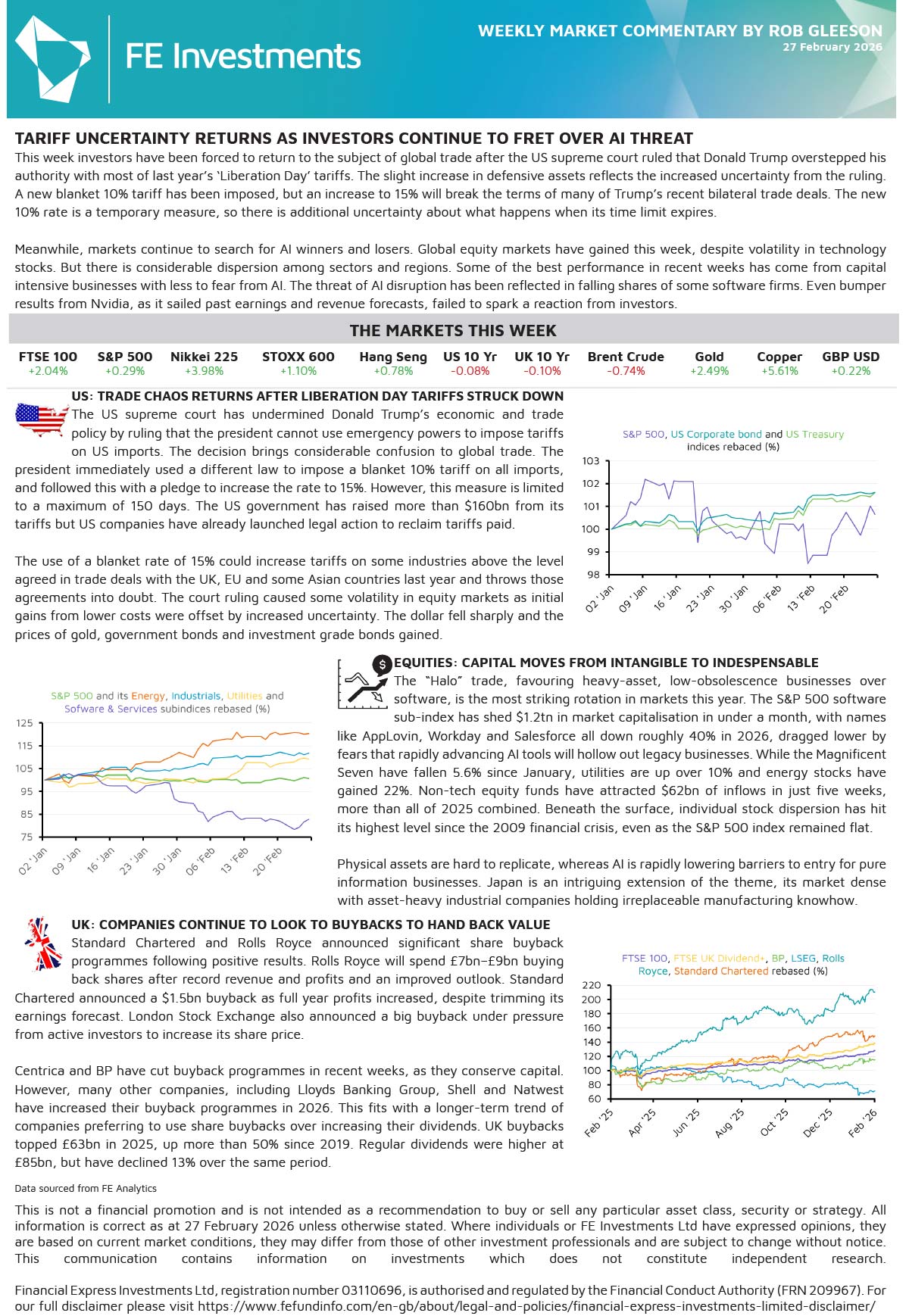
This week investors have been forced to return to the subject of global trade after the US supreme court ruled that Donald Trump overstepped his authority with most of last year’s ‘Liberation Day’ tariffs. The slight increase in defensive assets reflects the increased uncertainty from the ruling. A new blanket 10% tariff has been imposed, but an increase to 15% will break the terms of many of Trump’s recent bilateral trade deals. The new 10% rate is a temporary measure, so there is additional uncertainty about what happens when its time limit expires.
Meanwhile, markets continue to search for AI winners and losers. Global equity markets have gained this week, despite volatility in technology stocks. But there is considerable dispersion among sectors and regions. Some of the best performance in recent weeks has come from capital intensive businesses with less to fear from AI. The threat of AI disruption has been reflected in falling shares of some software firms. Even bumper results from Nvidia, as it sailed past earnings and revenue forecasts, failed to spark a reaction from investors.
US: TRADE CHAOS RETURNS AFTER LIBERATION DAY TARIFFS STRUCK DOWN
The US supreme court has undermined Donald Trump’s economic and trade policy by ruling that the president cannot use emergency powers to impose tariffs on US imports. The decision brings considerable confusion to global trade. The president immediately used a different law to impose a blanket 10% tariff on all imports, and followed this with a pledge to increase the rate to 15%. However, this measure is limited to a maximum of 150 days. The US government has raised more than $160bn from its tariffs but US companies have already launched legal action to reclaim tariffs paid.
The use of a blanket rate of 15% could increase tariffs on some industries above the level agreed in trade deals with the UK, EU and some Asian countries last year and throws those agreements into doubt. The court ruling caused some volatility in equity markets as initial gains from lower costs were offset by increased uncertainty. The dollar fell sharply and the prices of gold, government bonds and investment grade bonds gained.
EQUITIES: CAPITAL MOVES FROM INTANGIBLE TO INDESPENSABLE
The “Halo” trade, favouring heavy-asset, low-obsolescence businesses over software, is the most striking rotation in markets this year. The S&P 500 software sub-index has shed $1.2tn in market capitalisation in under a month, with names like AppLovin, Workday and Salesforce all down roughly 40% in 2026, dragged lower by fears that rapidly advancing AI tools will hollow out legacy businesses. While the Magnificent Seven have fallen 5.6% since January, utilities are up over 10% and energy stocks have gained 22%. Non-tech equity funds have attracted $62bn of inflows in just five weeks, more than all of 2025 combined. Beneath the surface, individual stock dispersion has hit its highest level since the 2009 financial crisis, even as the S&P 500 index remained flat.
Physical assets are hard to replicate, whereas AI is rapidly lowering barriers to entry for pure information businesses. Japan is an intriguing extension of the theme, its market dense with asset-heavy industrial companies holding irreplaceable manufacturing knowhow.
UK: COMPANIES CONTINUE TO LOOK TO BUYBACKS TO HAND BACK VALUE
Standard Chartered and Rolls Royce announced significant share buyback programmes following positive results. Rolls Royce will spend £7bn–£9bn buying back shares after record revenue and profits and an improved outlook. Standard Chartered announced a $1.5bn buyback as full year profits increased, despite trimming its earnings forecast. London Stock Exchange also announced a big buyback under pressure from active investors to increase its share price.
Centrica and BP have cut buyback programmes in recent weeks, as they conserve capital. However, many other companies, including Lloyds Banking Group, Shell and Natwest have increased their buyback programmes in 2026. This fits with a longer-term trend of companies preferring to use share buybacks over increasing their dividends. UK buybacks topped £63bn in 2025, up more than 50% since 2019. Regular dividends were higher at £85bn, but have declined 13% over the same period.
For more information regarding our weekly market reports, we encourage you to give us a call on 01732 746188 or send us an email at enquiries@foxgroveassociates.co.uk.
This document has been prepared for general information only. It does not contain all of the information which an investor may require in order to make an investment decision. If you are unsure whether this is a suitable investment you should speak to your financial adviser. This information is not guaranteed to be correct, complete, or accurate. Financial Express Investments Ltd, registration number 03110696, is authorised and regulated by the Financial Conduct Authority (FRN 209967). For our full disclaimer please visit https://www.fefundinfo.com/en-gb/about/legal-and-policies/.