-
INTERNATIONAL AND LOCAL POLITICS DRAG EQUITIES AND BONDS LOWER
Data Sourced from FE Analytics, and Bloomberg Finance LP
INTERNATIONAL AND LOCAL POLITICS DRAG EQUITIES AND BONDS LOWER
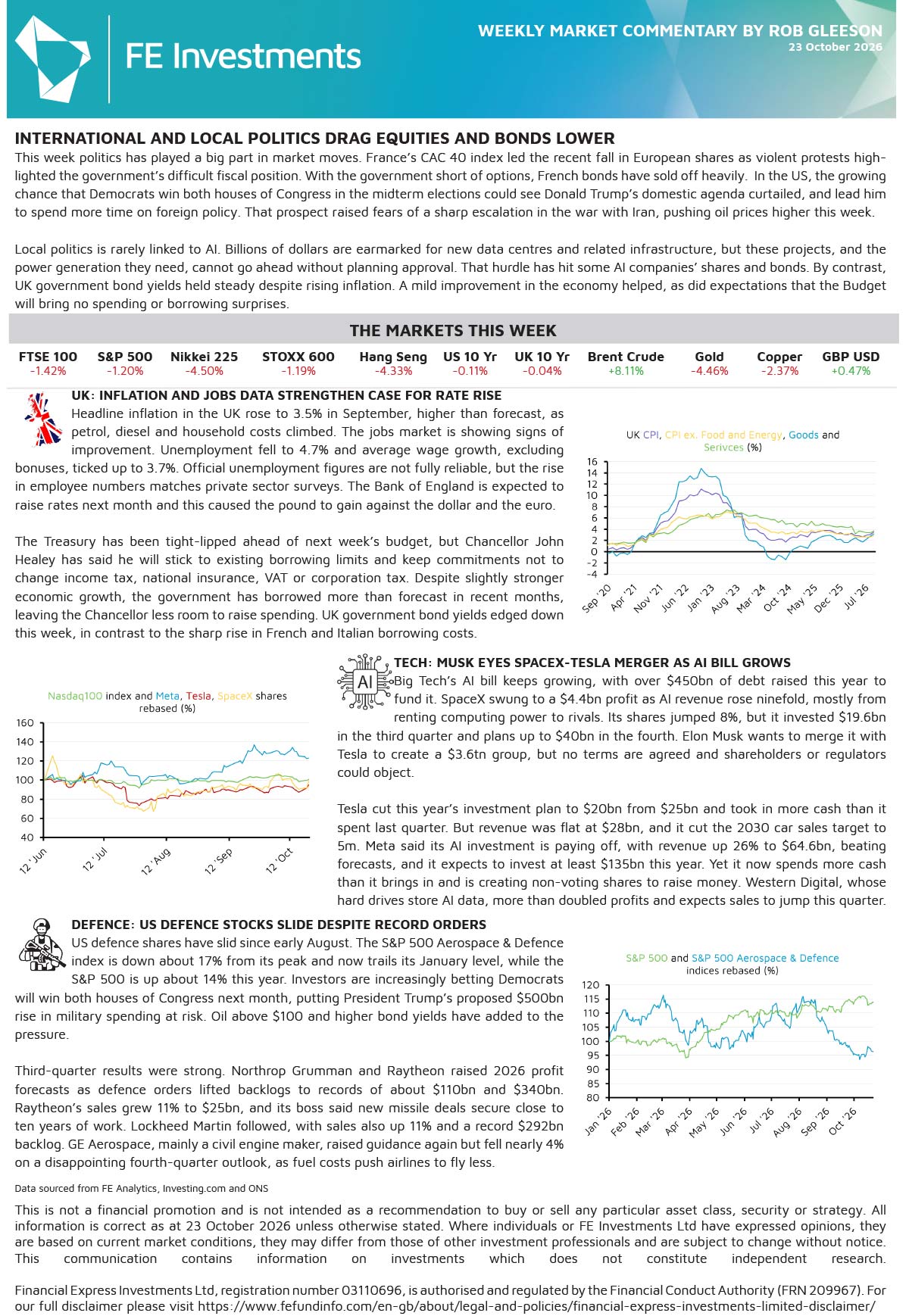
This week politics has played a big part in market moves. France’s CAC 40 index led the recent fall in European shares as violent protests high-lighted the government’s difficult fiscal position. With the government short of options, French bonds have sold off heavily. In the US, the growing chance that Democrats win both houses of Congress in the midterm elections could see Donald Trump’s domestic agenda curtailed, and lead him to spend more time on foreign policy. That prospect raised fears of a sharp escalation in the war with Iran, pushing oil prices higher this week.
Local politics is rarely linked to AI. Billions of dollars are earmarked for new data centres and related infrastructure, but these projects, and the power generation they need, cannot go ahead without planning approval. That hurdle has hit some AI companies’ shares and bonds. By contrast, UK government bond yields held steady despite rising inflation. A mild improvement in the economy helped, as did expectations that the Budget will bring no spending or borrowing surprises.
UK: INFLATION AND JOBS DATA STRENGTHEN CASE FOR RATE RISE
Headline inflation in the UK rose to 3.5% in September, higher than forecast, as petrol, diesel and household costs climbed. The jobs market is showing signs of improvement. Unemployment fell to 4.7% and average wage growth, excluding bonuses, ticked up to 3.7%. Official unemployment figures are not fully reliable, but the rise in employee numbers matches private sector surveys. The Bank of England is expected to raise rates next month and this caused the pound to gain against the dollar and the euro.
The Treasury has been tight-lipped ahead of next week’s budget, but Chancellor John Healey has said he will stick to existing borrowing limits and keep commitments not to change income tax, national insurance, VAT or corporation tax. Despite slightly stronger economic growth, the government has borrowed more than forecast in recent months, leaving the Chancellor less room to raise spending. UK government bond yields edged down this week, in contrast to the sharp rise in French and Italian borrowing costs.
TECH: MUSK EYES SPACEX-TESLA MERGER AS AI BILL GROWS
Big Tech’s AI bill keeps growing, with over $450bn of debt raised this year to fund it. SpaceX swung to a $4.4bn profit as AI revenue rose ninefold, mostly from renting computing power to rivals. Its shares jumped 8%, but it invested $19.6bn in the third quarter and plans up to $40bn in the fourth. Elon Musk wants to merge it with Tesla to create a $3.6tn group, but no terms are agreed and shareholders or regulators could object.
Tesla cut this year’s investment plan to $20bn from $25bn and took in more cash than it spent last quarter. But revenue was flat at $28bn, and it cut the 2030 car sales target to 5m. Meta said its AI investment is paying off, with revenue up 26% to $64.6bn, beating forecasts, and it expects to invest at least $135bn this year. Yet it now spends more cash than it brings in and is creating non-voting shares to raise money. Western Digital, whose hard drives store AI data, more than doubled profits and expects sales to jump this quarter.
DEFENCE: US DEFENCE STOCKS SLIDE DESPITE RECORD ORDERS
US defence shares have slid since early August. The S&P 500 Aerospace & Defence index is down about 17% from its peak and now trails its January level, while the S&P 500 is up about 14% this year. Investors are increasingly betting Democrats will win both houses of Congress next month, putting President Trump’s proposed $500bn rise in military spending at risk. Oil above $100 and higher bond yields have added to the pressure.
Third-quarter results were strong. Northrop Grumman and Raytheon raised 2026 profit forecasts as defence orders lifted backlogs to records of about $110bn and $340bn.Raytheon’s sales grew 11% to $25bn, and its boss said new missile deals secure close to ten years of work. Lockheed Martin followed, with sales also up 11% and a record $292bn backlog. GE Aerospace, mainly a civil engine maker, raised guidance again but fell nearly 4% on a disappointing fourth-quarter outlook, as fuel costs push airlines to fly less.
For more information regarding our weekly market reports, we encourage you to give us a call on 01732 746188 or send us an email at enquiries@foxgroveassociates.co.uk.
This document has been prepared for general information only. It does not contain all of the information which an investor may require in order to make an investment decision. If you are unsure whether this is a suitable investment you should speak to your financial adviser. This information is not guaranteed to be correct, complete, or accurate. Financial Express Investments Ltd, registration number 03110696, is authorised and regulated by the Financial Conduct Authority (FRN 209967). For our full disclaimer please visit https://www.fefundinfo.com/en-gb/about/legal-and-policies/.